How Much Does It Cost To Build A Backyard Basketball Court In Australia?

What does a backyard basketball court cost in Australia?
28 Sep
0
min read
A half court starts from around $18,000, and a full-size court from around $45,000, depending on surface, court size and what your site needs before the slab goes down. This guide breaks down what drives that cost, what you'll pay by size and surface, and the extra costs homeowners often miss.
Backyard Basketball Court Cost in Australia at a Glance
These figures are indicative only. Every backyard is different, and your final price depends on ground conditions, access for machinery, and how much civil work your site needs before the court itself goes in. The sections below explain exactly why one quote can look very different from another.
What Affects the Cost of a Backyard Basketball Court?
Court size
A half court needs less base preparation, less surfacing and a smaller hoop setup, so it's the cheaper starting point for most backyards. A full court roughly doubles the surface area and, with it, the concrete, coating and line-marking cost. Court size is usually the single biggest lever on your final number.
Surface material
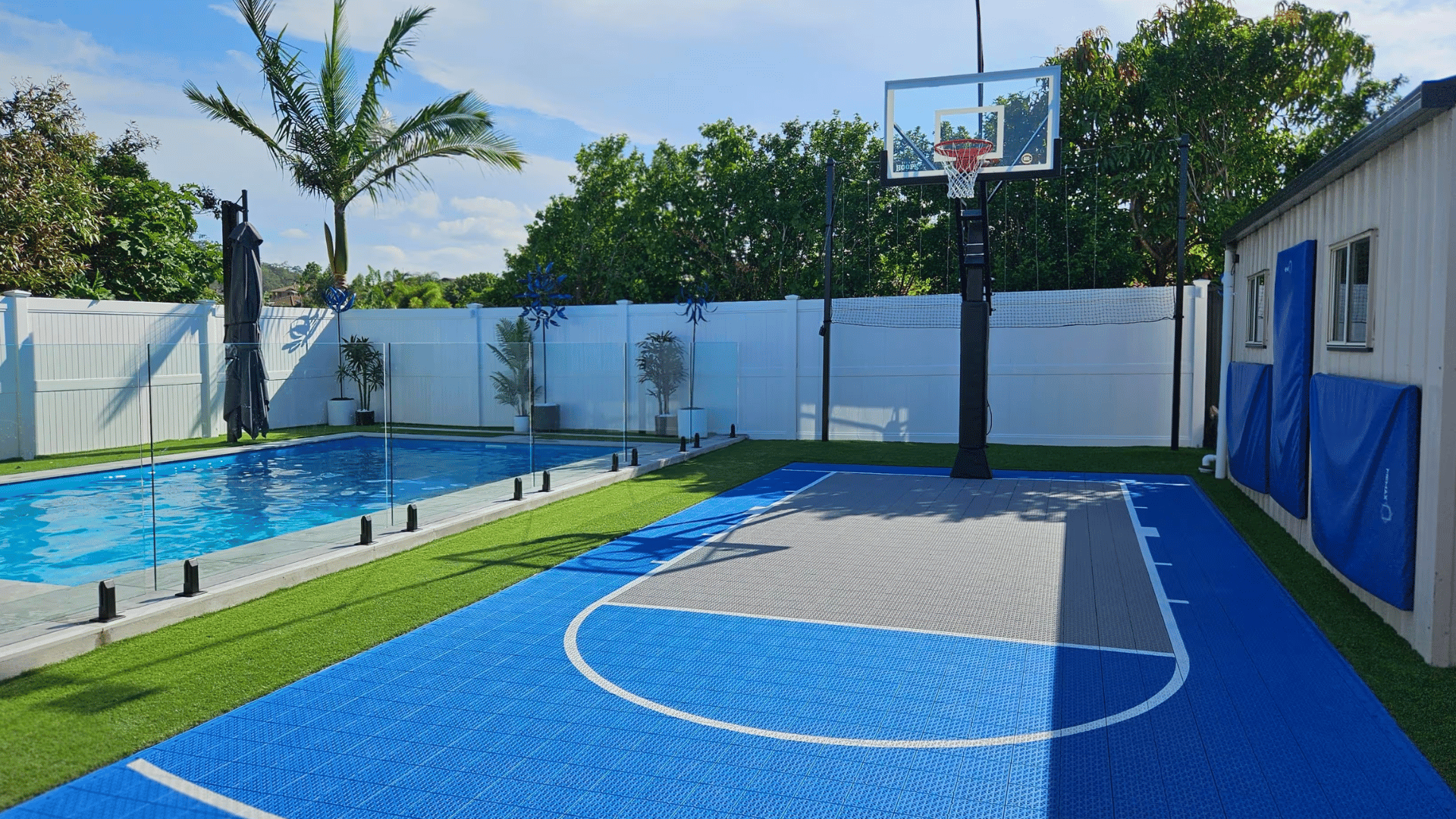
Polymer tile systems like our Elite Pro II and Elite X ranges click together over an existing hardstand or new slab, which keeps installation time and cost down while still giving proper ball bounce and grip. A poured acrylic system on a new concrete slab costs more upfront because it includes the slab itself, but it gives you a smoother, more premium finish and a longer resurfacing cycle.
Concrete and civil works
If your backyard doesn't already have a suitable hardstand, this is where a big share of your backyard basketball court installation cost sits. Excavation, base preparation, drainage and the concrete pour itself can cost more than the surfacing that goes on top of it, particularly on a sloped block or where the soil needs extra engineering.
This is also where site conditions across Australia genuinely change the price. Reactive clay soils common through parts of Sydney and Melbourne can mean a geotechnical report and a more heavily reinforced slab, while a sandy block in Perth or a rocky one in the Adelaide Hills each bring their own excavation challenges. A geotechnical assessment simply tells your builder what's under the surface, so the base is engineered to move and drain properly rather than crack in a few years.
Hoops and ring systems
A DreamHoops post and ring system is priced separately from the court surface, and the range varies with adjustability, backboard size and whether you want an in-ground or portable base. This is a cost most first-time buyers underestimate, and it's worth deciding early, since an in-ground post is usually installed before the surrounding surface goes down.
Fencing, lighting and accessories
Ball-containment fencing, court lighting for evening games and extras like key colouring or a logo inlay all add to the total. None of these are essential, but they're worth pricing in from the start if you know you'll want them eventually, since retrofitting later, particularly trenching for lighting, usually costs more than building it in from day one.
Half Court vs Full Court
Most suburban backyards suit a half court better than a full court, simply on space. Before deciding, it's worth checking the minimum backyard size for a basketball or half court against your own block, since court size drives both the layout and the price. A half court is enough for shooting drills, one-on-one and family games, and it's the more common choice for DreamCourts clients. A full court suits larger blocks and families who want to run proper two-on-two or three-on-three games, or who are building for a home business or coaching use.
Beyond raw space, think about how the court will actually be used day to day. A half court with a good hoop and a clean surface gets far more use in most families than an oversized full court that only comes out for the occasional game, and it leaves more of the backyard free for everything else. If space genuinely isn't a constraint, a full court gives you the flexibility to host proper games and, down the track, resell appeal to buyers who want the real thing rather than a compromise.
Surface Options: Concrete, Acrylic and Polymer Tile
Concrete on its own isn't a playable surface long-term. It needs a coating or tile system over the top for grip, ball bounce and joint protection.
Acrylic is applied directly onto a concrete slab in layers, giving a smooth, consistent surface with excellent rebound, which is simply how evenly and predictably the ball bounces back after it hits the surface. It's the surface most commonly seen on club and school courts, and it holds up well to Australian conditions when it's installed and maintained properly.
Polymer tile (our Elite Pro II and Elite X systems) interlocks over concrete, pavers or compacted base. It's faster to install, more forgiving of minor surface imperfections, and easier to repair section by section if a tile is ever damaged.
Hidden Costs to Budget For
The quotes that look cheapest on paper are often the ones missing line items that show up later. Before you compare prices, budget for:
Approvals. Some councils require development approval for a backyard court, particularly with fencing, lighting or a build near a boundary or easement. Rules vary by council and by whether the court counts as an outbuilding under local planning codes, so it's worth checking early rather than after your slab is poured.
Earthworks and drainage. Sloped or poorly draining blocks need extra excavation, cut-and-fill work or stormwater drainage before a court can go in. This is the single most common reason a final invoice comes in above an early estimate, and it's almost impossible to price accurately without seeing the site.
Retaining walls. If your court needs to be cut into a slope, retaining walls protect the court edge and your neighbouring garden beds, but they're rarely included in a base quote and can add several thousand dollars on a sloped block.
Lighting. Floodlights or post-mounted LEDs for evening play are a separate electrical cost, including any trenching and cabling needed to get power to the court from your switchboard.
Maintenance. Acrylic courts benefit from a recoat every several years to keep grip and colour consistent, and tile systems need the odd tile replaced if damaged, which is usually a simple swap rather than a full resurface. Factor this into the long-term cost of ownership, not just the build.
DIY vs Professional
A DIY build might look like a big saving on paper, but see our guide on what you can and can't do yourself before deciding. Most of the risk, and most of the cost blowouts, sit in the base preparation and surfacing steps, not the parts that look easy from the outside. Sourcing the right materials, getting cure timing right and managing weather delays can turn a weekend project into a months-long one.
A professional build costs more upfront but comes with sequenced trades, correct cure timing and a warranty on the finished surface. If you're weighing the two options, it's worth reading how long each actually takes from start to finish before you decide.
Does a Backyard Court Add Value to Your Home?
A well-built court is a genuine lifestyle drawcard, and buyers actively looking for basketball, pickleball or multi-sport facilities will pay attention to a well-finished one. It won't add value dollar-for-dollar the way a kitchen renovation might, but a quality court, properly integrated into the backyard rather than bolted on as an afterthought, is one of the more memorable features a family home can have.
The courts that hold their value best tend to be the ones built properly the first time: a correctly engineered base, a surface suited to the climate, and tidy edges and fencing rather than a slab dropped into an unfinished corner of the yard. A cheap build that needs resurfacing or re-levelling within a few years rarely feels like the saving it looked like on day one. Curious how quickly you could have one ready for summer? Here's how long a build actually takes.
Backyard Basketball Court Cost - FAQs
How much does a home basketball court cost?
A home basketball court typically costs between $18,000 for a smaller half court and $95,000 or more for a full-size court with a premium acrylic surface. Court size and surface type are the two biggest factors in the final price.
How much does it cost to install a basketball court?
Basketball court installation cost depends heavily on your site. If your backyard already has a suitable hardstand, installation is largely the surfacing and line-marking. If it needs excavation, a new slab or drainage work, civil costs can make up a large share of the total.
How much does a half court cost vs a full court?
A half court generally costs 40-60% less than a full court on the same site, since it needs a smaller surface area, less base preparation and a simpler hoop setup.
How much does it cost per square metre?
Indicative pricing sits roughly between $250 and $450 per square metre depending on surface type, though civil works on a difficult site can push this higher.
How long does it take to build?
A typical backyard court takes several weeks from approval to completion, most of it accounted for by base preparation and concrete cure time rather than the visible on-site work. See our full build timeline for a phase-by-phase breakdown.
Does a backyard court add value to my home?
It's more of a lifestyle investment than a guaranteed valuation lift, but a well-integrated, professionally finished court is a standout feature for family buyers. See the section above for more detail.
Build Your Backyard Basketball Court with DreamCourts
DreamCourts is Australia's number one court builder, completing more than 100 courts a month, and the only company licensed to feature NBA and NBL logos on residential builds. We're an official NBL and Basketball Australia Court Partner, ISO-accredited, and our work has featured on The Block.
We quote transparently from the first conversation, so you know what you're paying for and why, and we can walk you through interest-free options through HandyPay if you'd rather spread the cost. Ready to see what your backyard could look like?
Get a fixed-price, free quote or start designing your layout with our Court Designer.

Are you ready to make your hoop dreams a reality?
News


Testimonials


Name Surname
Position
Name Surname
Position
.avif)

Kane and Lucy Cornes
TV Personalities


Luke Hodge
AFL Legend


Kyle Adnan
Professional Basketball Player