What Affects the Cost of a Home Basketball Court?
7 Oct
0
min read
Roughly half of the total goes into the concrete and civil works underneath the court, not the surface you play on.
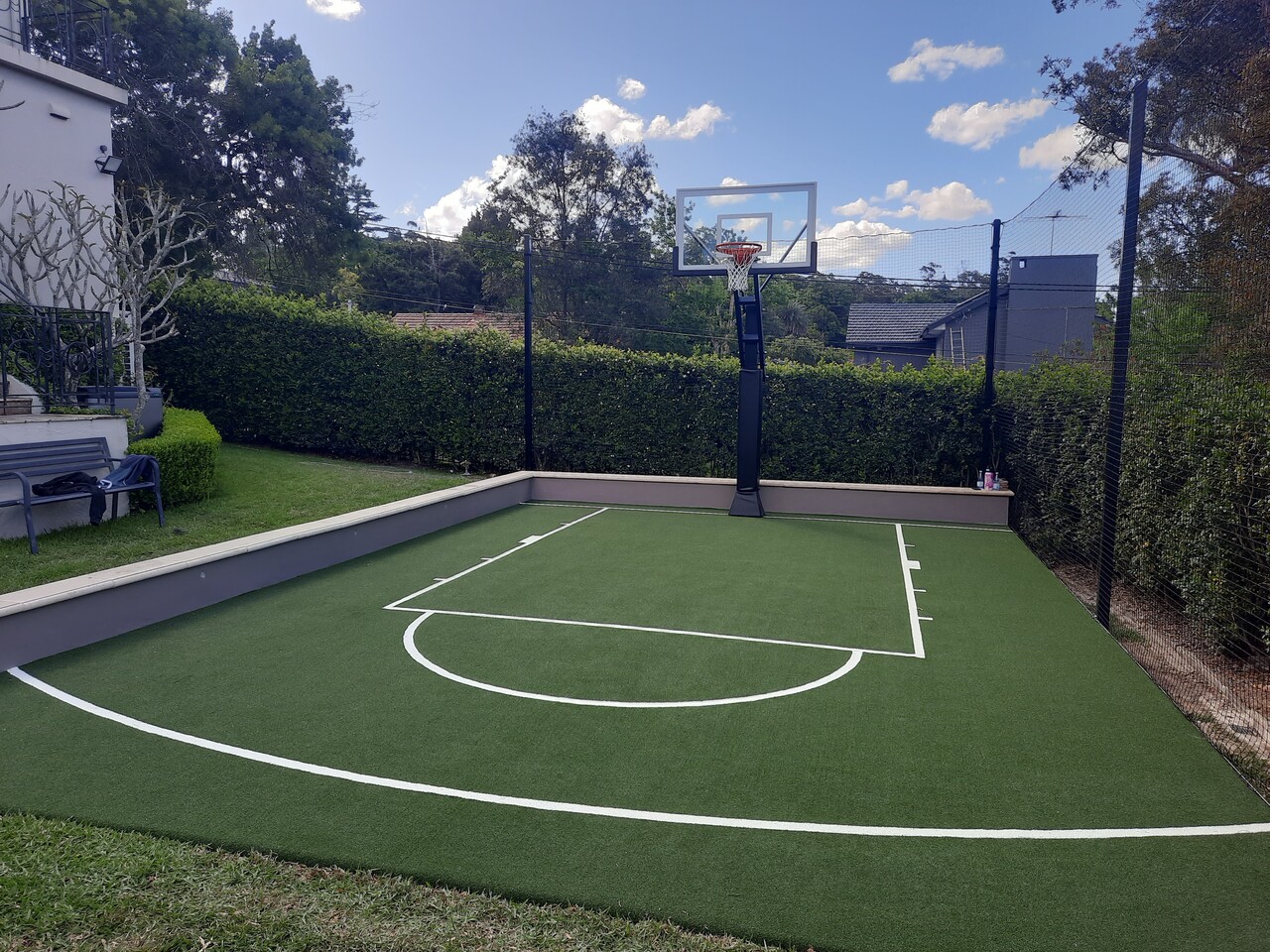
Every court is built on concrete, so a lawn or patch of bare ground needs that work done first. That is why two courts of the same size can be priced quite differently.
This article breaks down where the money goes: the cost structure, the base, polymer tile versus acrylic, driveway conversions, extras and finance. For price ranges by court size, see our backyard basketball court cost guide.
What makes up the cost of a home basketball court?
The cost of a home basketball court splits into two main parts. Concrete and civil works make up roughly half, and design, surfacing and finishing make up the other half. Extras such as the hoop system, netting and lighting are priced on top, so two quotes are only comparable when they include the same items.
The split is a guide, not a fixed rule. A sloping block, reactive soil or limited machinery access pushes the first half up. A detailed multi-sport layout or a premium surface pushes the second half up. The Court Designer lets you set the size and layout before you speak to us, which gives your quote a clearer starting point.
Why does a basketball court need a concrete base?
A basketball court cannot sit on grass or bare soil. It needs a flat, stable and well-drained slab, and that slab has to be in place before any surface goes down. This applies whichever surface you choose, which is why concrete and civil works come first in every project.
The work includes:
- Excavation and levelling of the site
- Drainage and fall, so water runs off the court instead of pooling
- A reinforced concrete slab
- Curing time before any surface is laid
Site conditions move this half of the cost more than anything else. Slope, soil type, machinery access, retaining walls and existing services such as pipes and cables all change how much preparation a site needs. A flat, open backyard with easy access sits at one end. A sloping block with a fence line to work around sits at the other.
So, can you build a basketball court on grass? Not directly. The turf is removed, the ground is prepared and the slab is poured first. DreamCourts supplies a concrete plan and set-out diagrams for the agreed design, along with DreamHoop anchor plate kits and sleeves for containment netting poles, so the concrete team can set everything in place at the right time. Depending on location, the concrete can be coordinated through trusted partners in NSW, VIC, SA, QLD and WA, or completed by your own trades.
How does surface choice change the cost: polymer tile or acrylic?
The surface is the largest part of the finishing half of the cost. Polymer tiles are laid over the slab as an interlocking modular system, while acrylic is applied to the slab in coats. The two differ in how they are installed, how they feel underfoot and how they are looked after.
The concrete base is the same for both, so the cost difference sits in the surface itself. DreamCourts offers the Elite Pro II and Elite X II polymer tile range, which you can compare on the Court Tiles page. A site assessment and quote shows the difference for your court.
Can you turn a driveway into a basketball court?
Often, yes. An existing slab in good condition can reduce the concrete and civil works, which is the largest part of the cost of a court. Whether a driveway is suitable depends on its condition, its level and its size, and a site assessment confirms whether it can be used as it is, repaired or replaced.
Before a driveway is used as a court base, these need checking:
- Condition of the slab, including cracks, movement and surface finish
- Level and fall, and how water drains off it
- Size compared with the court dimensions and the run-off needed around the playing area, which our sports court dimensions guide covers
- Hoop position and footing, and how stray balls will be kept off the street and away from neighbouring fences
The assessment decides how much the cost comes down. A sound slab may only need surfacing, a cracked one may need repair first, and a driveway with poor drainage may need to
be replaced. Our design and installation team can assess your driveway before you commit to anything.
What extras change the total cost?
Extras sit on top of the court and are priced separately:
- Basketball hoop system - fixed height, adjustable from 5.5ft to 10ft, or wall mounted
- Netting or fencing - retractable soft netting or cyclone fencing to keep the ball on the court
- Lighting - for evening play
- Line marking and colours - including multi-sport layouts, which the multi purpose courts page covers
- Freight - confirmed per location for regional sites, so a regional build can differ from a metro one
The way the work is split changes what a quote includes. DreamCourts can project manage the whole build, work alongside your own trades, or supply only for a DIY build. Check that any quotes you compare cover the same scope.
Can you finance a home basketball court?
Finance is available for home court projects through DreamCourts' HandyPay interest-free finance option. The finance page sets out how it works, so you can plan the payments around the finished quote. A quote comes first, because the amount to finance depends on the base, surface and extras your site needs.
Read more on the HandyPay finance page, or request a free quote to see the numbers for your court.
Get a cost estimate for your court
Every court is different, so the most reliable way to get a number is a design and quote based on your site. Use the Court Designer to set the size and layout, then get a free quote.
DreamCourts is an official NBL court partner and the official licensee for NBA team and league logos on courts in Australia. State-based operations managers in NSW, VIC, SA, QLD and WA guide each project from design to installation.
FAQs
Does a home basketball court need a concrete base?
Yes. A court needs a flat, stable and well-drained slab, whichever surface goes on top. Concrete and civil works come first, and they make up roughly half of the total cost of a home court. An existing slab in good condition can sometimes be used instead of pouring a new one.
Can I build a basketball court on grass?
Not directly. Grass and topsoil are removed, the ground is levelled and drained, and a concrete slab is poured before the surface is laid. This preparation is part of every home court build, and it is why a lawn site usually costs more to prepare than a site with an existing slab.
Why do two courts of the same size cost different amounts?
Size is only one factor. The site (slope, soil, access and drainage), the surface, the extras and
the distance for freight all change the total. Two quotes are only comparable if they cover the same base work, the same surface and the same extras, so check what each one includes.
Is it cheaper to use an existing slab or driveway?
It can be, because the concrete and civil works are the largest part of the cost. The slab needs to be in good condition, level enough to drain and large enough for the court and its run-off. A site assessment confirms whether it can be used as it is, repaired or replaced.

Are you ready to make your hoop dreams a reality?
News




Testimonials


Name Surname
Position
Name Surname
Position


Kane and Lucy Cornes
TV Personalities


Luke Hodge
AFL Legend


Kyle Adnan
Professional Basketball Player